Best cycle syncing app in 2026: an honest comparison
Different apps optimize for different jobs. The full comparison below covers stated focus, pricing, privacy posture, and where each one falls short.
Quick comparison
| App | Best for | Price | Privacy | Account required |
|---|---|---|---|---|
| Lumen | Productivity scheduling | Free | All data in browser | No |
| Flo | Period + symptom tracking | Free + premium tier | Cloud, post-FTC settlement | Yes |
| Clue | Period + symptom tracking | Free + premium | Cloud, EU-based | Yes |
| Natural Cycles | Fertility awareness as birth control | $99/yr | Cloud, FDA-cleared | Yes |
| MyFlo | FloLiving lifestyle prescriptions | $4.99/mo | Cloud | Yes |
| 28 by Brittany Hugoboom | Phase content + check-ins | Subscription | Cloud | Yes |
Lumen
Lumen is a free cycle-aware productivity planner. It calculates the current phase from three inputs (last period start, cycle length, period length) and recommends which task types fit which phase: deep work in follicular, presentations in ovulatory, editing in luteal, reflection in menstrual.
Strengths:
- Only app focused on productivity rather than fertility, period prediction, or wellness prescriptions
- All data stays in the browser; no account, no email, no server storage
- Free, no premium tier, no upsell
- Methodology is published with peer-reviewed sources
Weaknesses:
- Does not track period symptoms, mood, or fertility signs (it is not a tracker)
- No predictive cycle modeling (uses standard 14-day luteal rule, not personalized)
- No community, no chat, no coaching
- Does not yet support hormonal contraception, perimenopause, PCOS, or thyroid variants
Best for: women who want to schedule their work week around cycle phases without giving up data to another company.
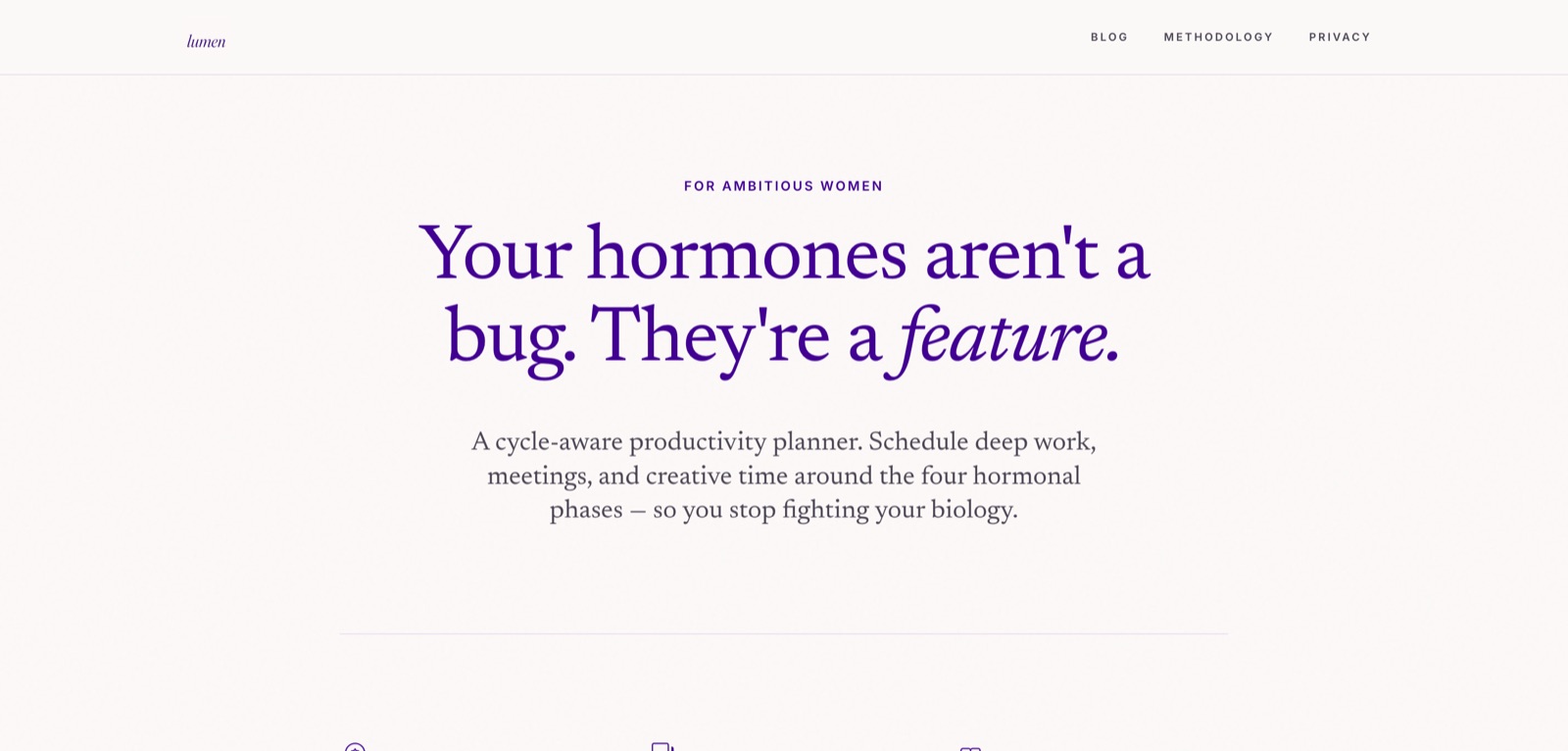
Lumen homepage. Captured 2026-04-29.
Flo
Flo is the largest period tracker globally with 380+ million users. Strong at period prediction, symptom logging, and AI-driven cycle insights.
Strengths:
- Best-in-class period prediction accuracy for users who log consistently
- Comprehensive symptom and mood tracking
- Health content library with input from medical advisors
- Free tier covers the basics
Weaknesses:
- 2021 FTC settlement over sharing health data with Facebook and Google. Privacy controls have improved but the trust deficit is real.
- Premium tier ($10/mo) gates the most useful insights
- Productivity recommendations are surface-level, not phase-specific
Best for: women who primarily want to track periods and symptoms and are comfortable with cloud data storage.
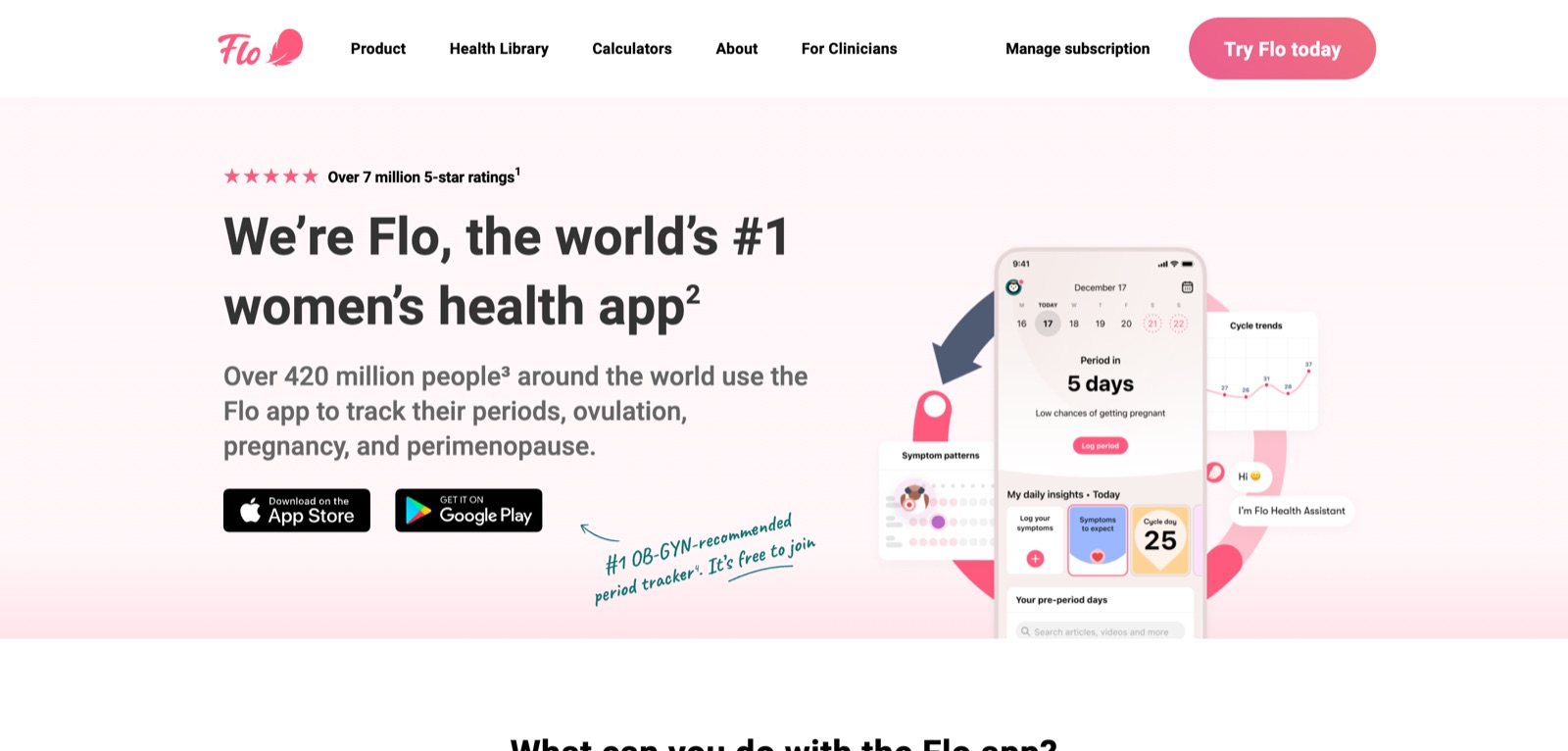
Flo homepage. Source: flo.health, captured 2026-04-29.
Clue
Clue is the European answer to Flo. Berlin-based, GDPR-native, more privacy-forward than Flo by default.
Strengths:
- Strong scientific advisory board, transparent methodology
- GDPR-native, less aggressive with data sharing
- Clean interface, less wellness-marketing voice
- Free tier is genuinely usable
Weaknesses:
- Still cloud-stored data; not zero-trust the way Lumen is
- Premium tier necessary for advanced predictions
- Productivity content is general-wellness, not phase-by-task-type
Best for: privacy-conscious users who want a tracker, not a productivity tool, and prefer the European data regime.
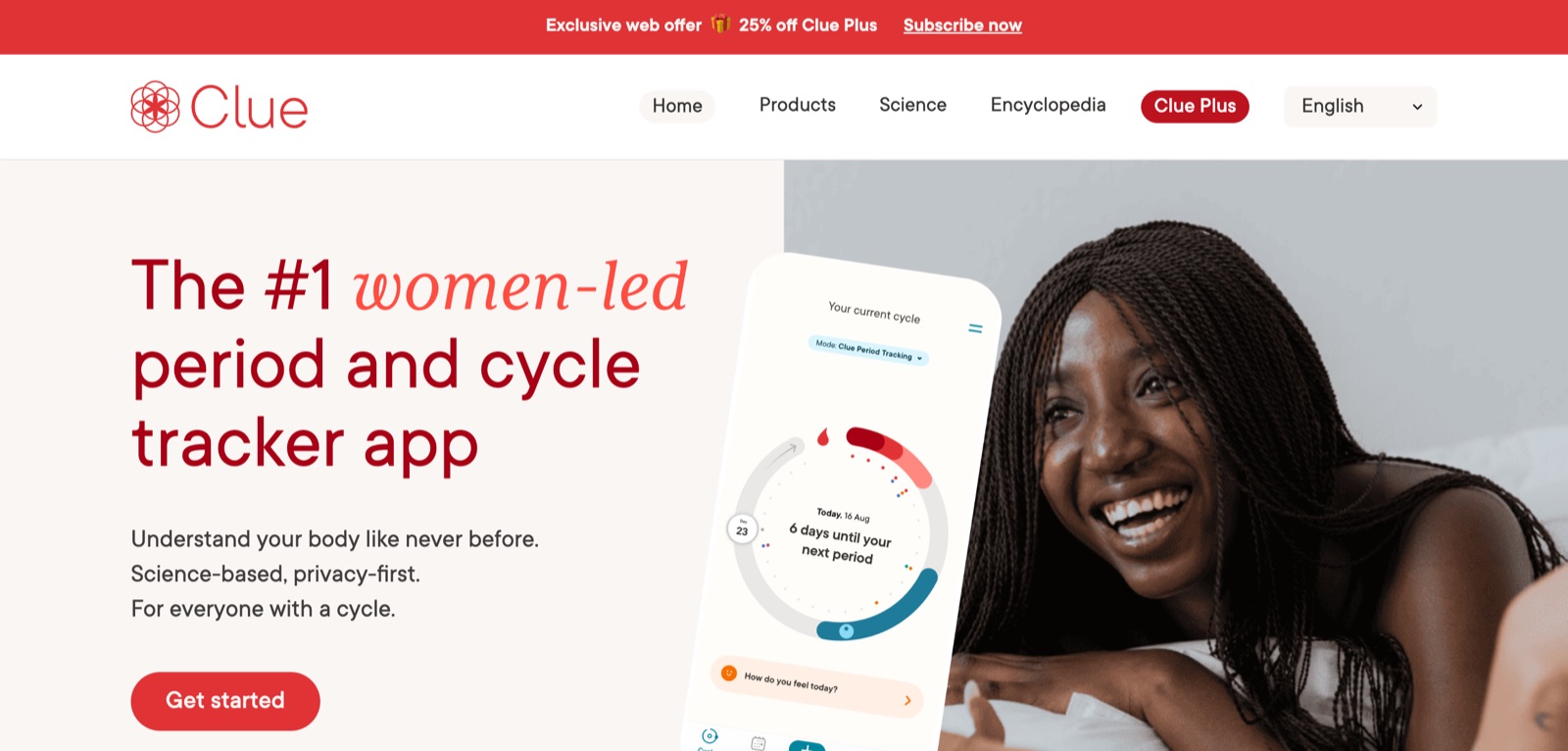
Clue homepage. Source: helloclue.com, captured 2026-04-29.
Natural Cycles
Natural Cycles is the only FDA-cleared app for fertility awareness as a contraceptive method. It uses basal body temperature plus cycle data.
Strengths:
- FDA-cleared as a contraceptive method (the only app in this category)
- Data-rich approach with daily temperature input
- Pairs with wearable thermometers and Apple Watch Ultra
Weaknesses:
- $99/year, no free tier
- Requires daily temperature measurement at the same time each morning
- Effectiveness depends heavily on user compliance
- Not focused on productivity
Best for: women using fertility awareness as their primary contraceptive method, willing to commit to daily measurement.
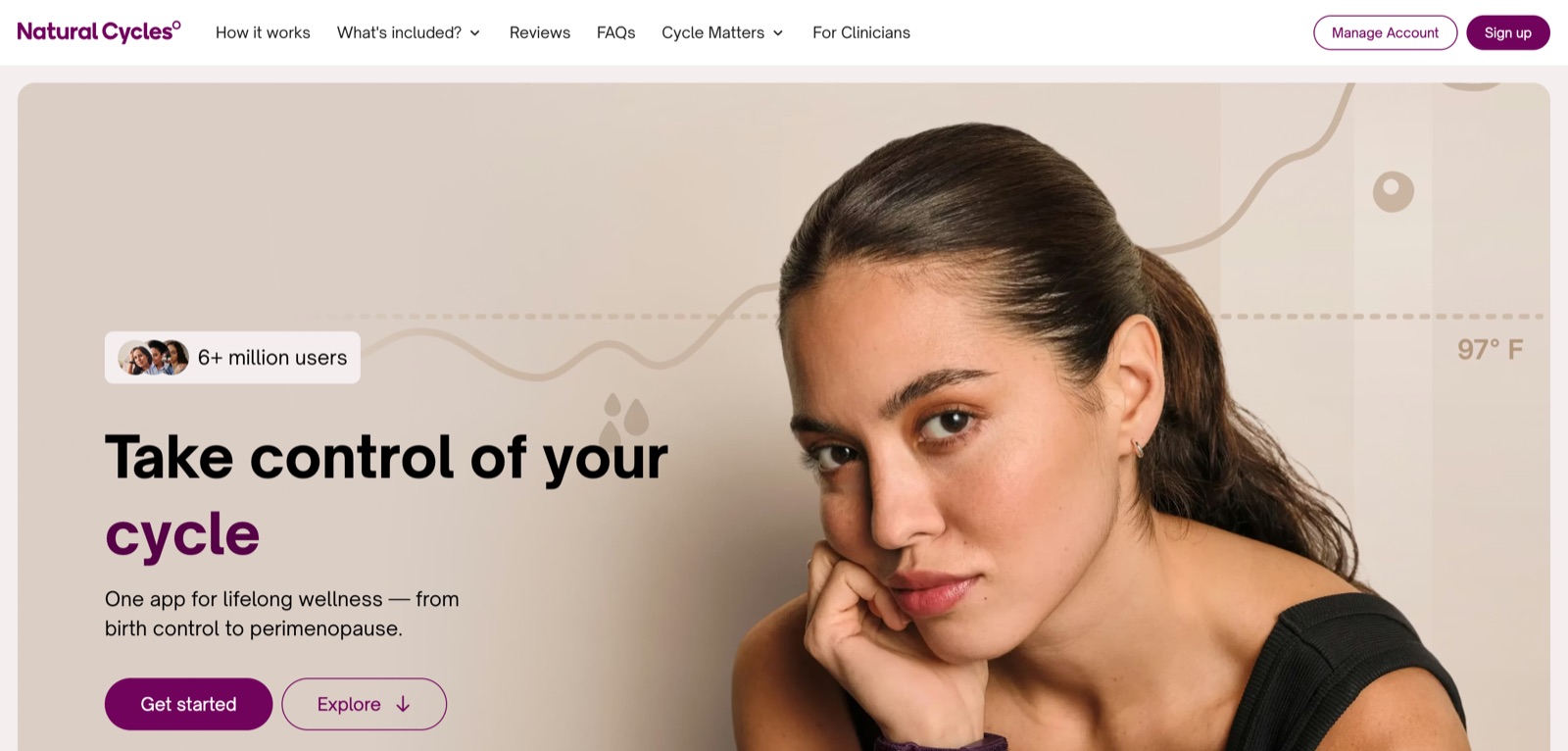
Natural Cycles homepage. Source: naturalcycles.com, captured 2026-04-29.
MyFlo
MyFlo is the official app of Alisa Vitti's FloLiving methodology, the source of the "cycle syncing" term as commonly used.
Strengths:
- The most prescriptive cycle syncing app, with specific food, exercise, and task recommendations per phase
- Deep wellness content from FloLiving's clinical team
- Strong community of FloLiving followers
Weaknesses:
- Strongest claims (specific foods per phase, "seed cycling") have weak research backing
- Subscription pricing
- Wellness-marketing voice may not fit all users
- More prescriptive than evidence supports
Best for: users who want to follow a specific lifestyle program and are comfortable with the FloLiving framework.
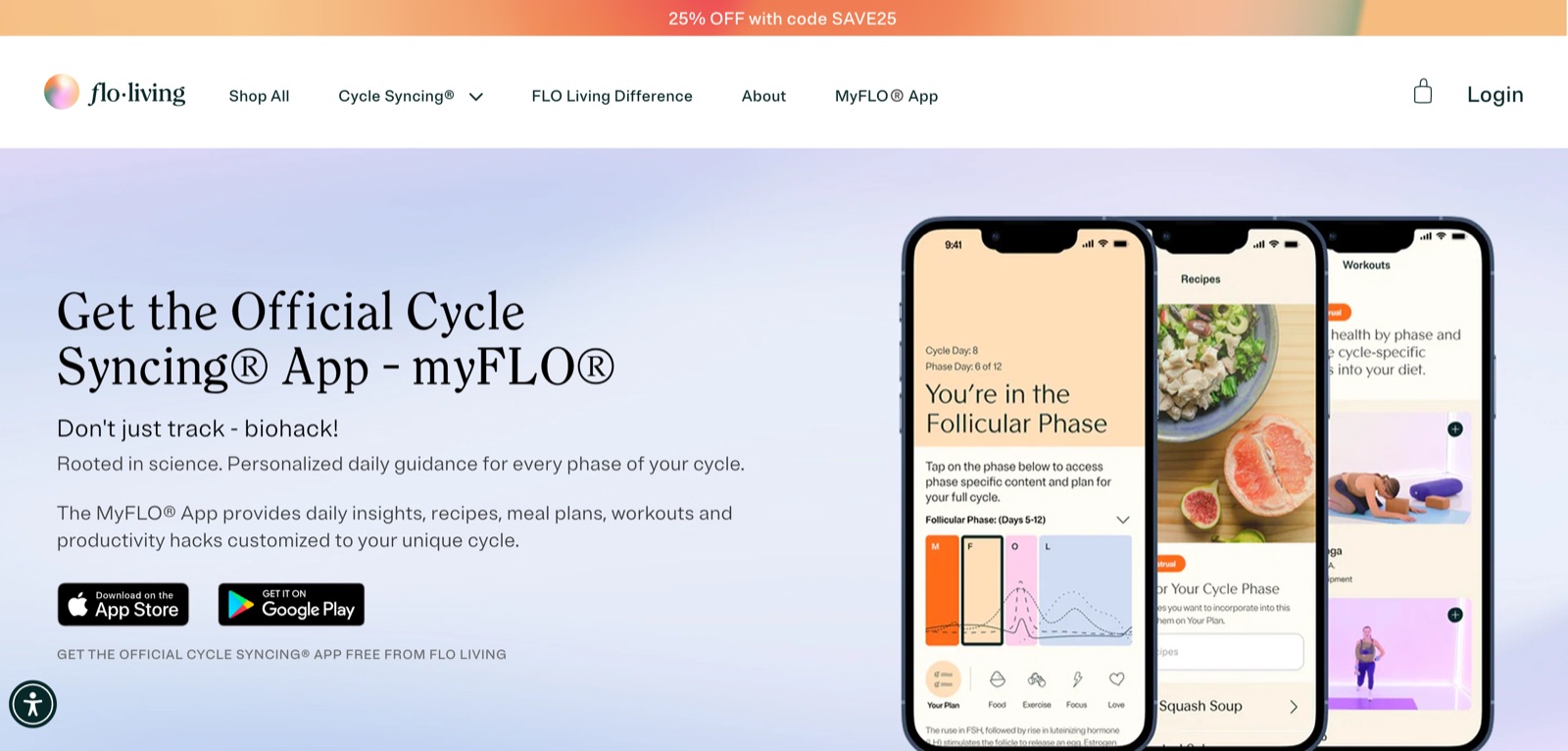
MyFLO app page on FLOliving. Source: floliving.com, captured 2026-04-29.
28 by Brittany Hugoboom
28 (also known as 28 Wellness) is a phase-based wellness app pairing daily content with check-ins.
Strengths:
- Daily content cadence that builds habit
- Pairs cycle education with practical lifestyle prompts
- Less prescriptive than MyFlo, more guided than Clue
Weaknesses:
- Subscription required
- Heavier on lifestyle and aesthetic, lighter on data
- Not productivity-focused
Best for: users who want a wellness companion with daily prompts, not just a tracker.
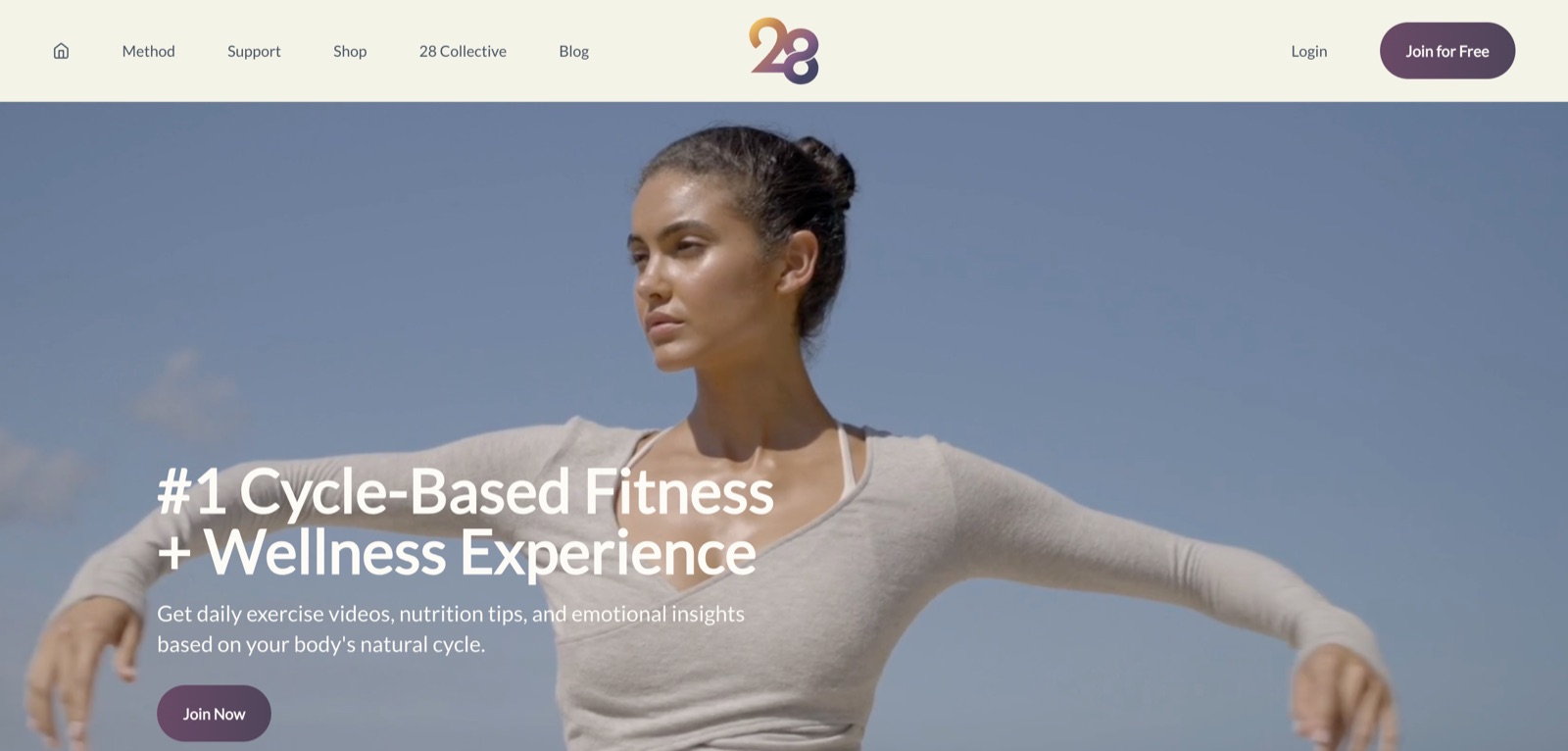
28 homepage. Source: 28.co, captured 2026-04-29.
How to choose
Pick by the job you want done:
- Schedule work around your cycle: Lumen. Free, private, productivity-focused.
- Predict your period accurately: Flo or Clue. Both work; Clue if privacy matters more.
- Use fertility awareness as birth control: Natural Cycles, with a wearable thermometer.
- Follow a complete lifestyle prescription: MyFlo, if you align with the FloLiving framework.
- Build a daily wellness habit: 28, for the prompts and content cadence.
The most common mistake is using a period tracker (Flo, Clue) and expecting it to also tell you when to schedule deep work. They are different jobs. A period tracker tells you when your period will come. A productivity planner like Lumen tells you what to do with your week given where you are.
If you want the book version
Apps are not the only format. A few books cover the same ground in more depth, and three are worth knowing about regardless of which app you pick.
- WomanCode by Alisa Vitti. The 2014 book that popularized the term cycle syncing and the source material for the MyFlo app and FloLiving framework. Best if you want the prescriptive lifestyle system in its original form.
- In the FLO by Alisa Vitti. Vitti's 2020 follow-up, expanded with the four-phase work-and-life prescription model.
- Period Repair Manual by Lara Briden. A naturopathic doctor's more clinically-cautious take on cycle health, useful as a counterweight to the Vitti framework.
Why a separate productivity app exists at all
The cycle-and-cognition research base is solid enough to make decisions on but not solid enough to embed in a clinical product. Period trackers don't make productivity recommendations because doing so without clinical validation is risky for them. Productivity apps don't model the cycle because most are designed gender-neutrally.
Lumen sits between the two: it does not claim to be medical (it is not), but it does translate cycle physiology into a weekly plan that is useful at a 5-point-rating level of resolution. It is the smallest possible tool that still does the job. Try it free, no signup, takes 30 seconds.
A note on data
Whichever app you choose, the data you give it is sensitive. Cycle data plus location plus device identifiers can reveal pregnancy, fertility status, and health context that some users would not voluntarily share. Read the privacy policy before logging the first cycle. Apps with server-stored models should disclose what they do with the data and who they share it with. Apps with local-only storage (like Lumen) cannot share what they do not have.